
The Last 3 Months in AI: The Innovations That Are Changing the Technology Landscape
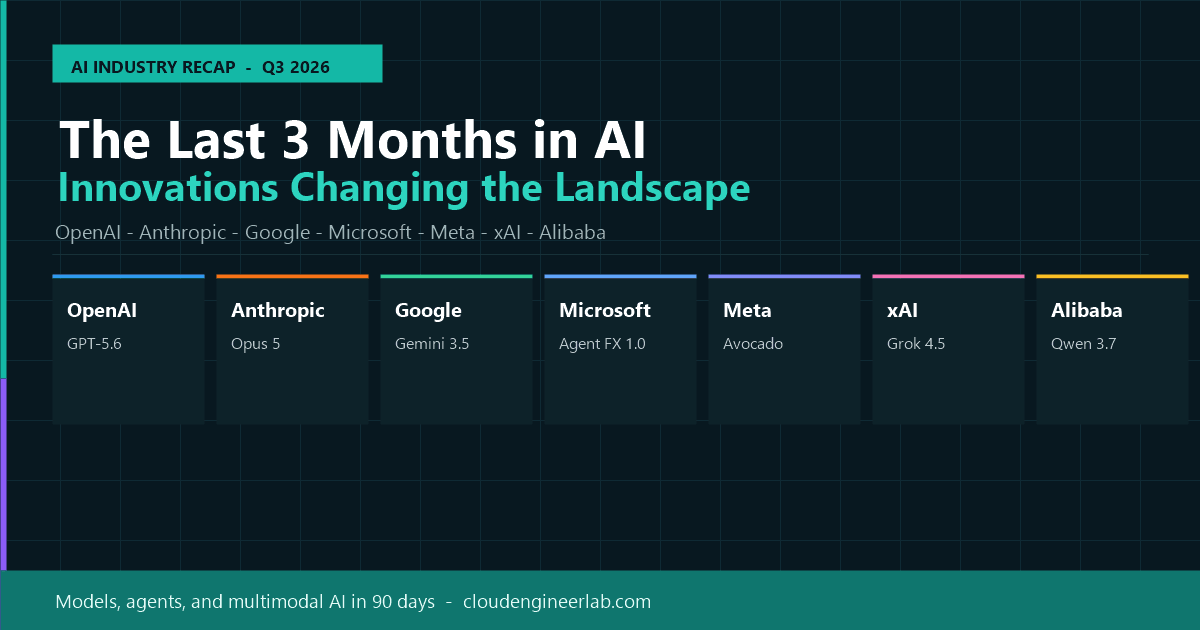
OpenAI, Google, Anthropic, Microsoft, Meta, xAI, and Alibaba all shipped major AI releases in the last three months. Here's what changed, why it matters, and what to learn next.
Three months. That's all it took for the AI industry to ship a new frontier model family from OpenAI, three new Claude generations from Anthropic, a fully multimodal Gemini line from Google, an agent-first pivot at Microsoft's two biggest conferences, a Qwen-trained model from Meta, a new Grok from xAI, and enough Alibaba downloads to overtake Llama as the world's most-used open model family.
If you stopped paying close attention for a quarter, the landscape underneath you has genuinely moved. This is the recap — what actually shipped, why it matters, and what it means for the skills you should be building right now.
What Changed in the Last Three Months?
The headline shift isn't any single model — it's the direction every major lab moved in at the same time:
Every company covered in this post shipped something that fits at least one of those four shifts in the last quarter alone.
Company-by-Company: What Actually Shipped
OpenAI — GPT-5.6 and GPT-Live
OpenAI publicly released the GPT-5.6 family on July 9, 2026, following an earlier limited rollout to government partners for safety evaluation. It ships as three variants:
| Model | Positioning |
|---|---|
| Sol | The workhorse — OpenAI's primary model for enterprise, coding, and scientific work |
| Terra | A mid-tier balance of capability and cost |
| Luna | The budget-friendly option for high-volume, lower-complexity tasks |
OpenAI is calling Sol 54% more token-efficient on coding tasks than its predecessor, and positions GPT-5.6 as its strongest cybersecurity model yet — achieving frontier-level performance with meaningfully fewer tokens per task. A day before, OpenAI also introduced GPT-Live, a new generation of voice models built for real-time conversational use.
Anthropic — Fable 5, Sonnet 5, and Opus 5
Anthropic had the busiest quarter of any lab covered here, shipping three model generations back to back:
- Fable 5 (June 9) — the introduction of Anthropic's Mythos-class models, its most capable reasoning tier
- Sonnet 5 (June 30) — the balanced, general-purpose model for day-to-day coding and knowledge work
- Opus 5 (July 24) — positioned as reaching near-Fable-5 capability at roughly half the cost, with a 1-million-token context window, up to 128K output tokens, adaptive thinking enabled by default, and a five-level effort setting for tuning speed against depth
Why Opus 5 is the interesting one
Opus 5 isn't the biggest model Anthropic shipped this quarter — it's the one built to make frontier-adjacent reasoning affordable for everyday coding and knowledge work, rather than reserved for the highest-cost tier. That cost-down-without-capability-down pattern shows up across every lab this quarter, not just Anthropic.
For a deeper look at Anthropic's broader tool ecosystem — Claude Code, Model Context Protocol, Computer Use — see Anthropic in 2026: Everything Enterprise Teams Need to Know.
Google — Gemini 3.5, Gemini Omni, and Computer Use
At Google I/O 2026, Google introduced two new model lines: Gemini Omni, built to generate across any input starting with video, and Gemini 3.5, the first Gemini family combining frontier reasoning with real-world action. Gemini 3.5 Flash outperforms the earlier Gemini 3.1 Pro on several coding and agentic benchmarks, while running faster and cheaper.
Through June, Google extended this further:
- Gemini Omni Flash reached public preview via API — a natively multimodal model for building dynamic, custom video workflows
- Computer use was integrated directly into Gemini 3.5 Flash, letting developers build agents that see, reason, and act across desktop, mobile, and browser environments
- Nano Banana 2 Lite launched as Google's fastest, most cost-efficient image model
Microsoft — Agentic Windows and Microsoft IQ
Microsoft used Build 2026 (June, San Francisco) to reposition Windows itself as a platform for building and running AI agents — not just AI-assisted apps. Satya Nadella's keynote centred on agentic systems: AI that acts on your behalf without direct supervision.
Key announcements:
| Announcement | What it does |
|---|---|
| Microsoft IQ | A context layer feeding agents real workplace knowledge (Work IQ), structured business data (Fabric IQ), and web grounding (Web IQ) — now GA across GitHub Copilot, Foundry, and Copilot Studio |
| GitHub Copilot App | Per-session model selection, MCP server connections, cloud sessions, scheduled automations, agentic browsing |
| Microsoft Agent Framework 1.0 | The formal merger of AutoGen and Semantic Kernel into one commercially supported multi-agent SDK |
| Surface RTX Spark Dev Box | Local hardware for running large models on-device |
This builds directly on the shift Microsoft signalled at Ignite 2026 Paris earlier this year, where autonomous Copilot agents moved from preview into general availability. If you missed that recap, it's covered in full in Microsoft Ignite 2026 Paris: Every Major Announcement.
Meta — Training on Qwen, and Muse Spark 1.1
The most surprising story of the quarter: Meta is reportedly using Alibaba's Qwen to help train its next model, code-named Avocado — a genuine role reversal for a company that built its reputation on open-sourcing Llama. Meta also shipped Muse Spark 1.1 on July 9, 2026, a smaller update alongside the bigger strategic shift.
xAI — Grok 4.5
xAI released Grok 4.5 on July 8, 2026, continuing its rapid release cadence and tighter integration with the X platform for real-time data grounding.
Alibaba — Qwen Overtakes Llama
Alibaba had arguably the biggest structural win of the quarter without shipping a flashy keynote. Qwen3.7-Max launched May 20, 2026 as a proprietary, API-only model via Alibaba Cloud Model Studio. More importantly, the Qwen model family crossed one billion cumulative downloads, officially overtaking Meta's Llama as the world's most widely used open-source AI model family — a milestone that says as much about where open-source AI development has shifted as any single model release does.
The Snapshot Table
| Company | Headline release | Date | The pattern it fits |
|---|---|---|---|
| OpenAI | GPT-5.6 (Sol, Terra, Luna) + GPT-Live | Jul 8–9 | Efficiency + voice |
| Anthropic | Fable 5 → Sonnet 5 → Opus 5 | Jun 9 – Jul 24 | Frontier cost-down |
| Gemini 3.5, Gemini Omni, Computer Use | May – Jun | Multimodal + agentic | |
| Microsoft | Agentic Windows, Microsoft IQ, Agent Framework 1.0 | Jun (Build) | Agents as product |
| Meta | Avocado (Qwen-assisted), Muse Spark 1.1 | Jul 9 | Open-source role reversal |
| xAI | Grok 4.5 | Jul 8 | Rapid iteration |
| Alibaba | Qwen3.7-Max, 1B downloads milestone | May 20 – Jul | Open-source leadership |
Why This Matters — The Real Signal Behind the Releases
AI Is No Longer Just "Generating Text"
Gemini Omni working from video input, Computer Use agents operating a browser, GitHub Copilot's agentic browsing — these all point to the same shift: models are increasingly expected to reason across data types and take action inside software, not just produce a written response to a written question.
Agents Moved From Demo to Default
A year ago, "AI agent" mostly meant a conference demo. This quarter, Microsoft Agent Framework 1.0 became a commercially supported SDK, Ignite-era Copilot agents reached GA, and Google shipped Computer Use directly into a broadly available model tier. Autonomous, multi-step AI execution is now a procurement line item, not a research preview.
Frontier Intelligence Is Getting Cheaper, Fast
Claude Opus 5 delivering near-Fable-5 reasoning at half the cost, and GPT-5.6 Sol being 54% more token-efficient at coding, are the same story told twice: the gap between "the best model" and "an affordable model" is closing quarter over quarter. That changes the calculus for which model a team should default to for routine work.
The Open-Source Centre of Gravity Has Shifted
Qwen overtaking Llama in cumulative downloads — and Meta reportedly training its next model with Qwen's help — is a genuinely notable shift. Two years ago, Llama was the default answer to "what's the best open-weight model." That answer is no longer obvious.
Don't anchor to any one lab
If your team standardised on a single provider's model eighteen months ago and hasn't revisited that choice, this quarter alone is a good reason to. The cost-performance leaderboard is being reshuffled every few weeks right now.
Skills to Develop to Stay Relevant
The specific model names in this post will be outdated within a year. The underlying skills won't be.
Learn to evaluate models on trade-offs, not hype
Every release this quarter came with a cost/capability trade-off — cheaper-but-nearly-as-good, or faster-but-narrower. Build the habit of checking benchmarks and cost-per-token for your actual use case before switching, rather than chasing whichever model launched most recently.
Get hands-on with agent orchestration, not just chat
Microsoft Agent Framework, MCP servers, and Computer-Use-style agents are becoming standard enterprise tooling. Understanding how an agent plans, calls tools, and hands off tasks is now a more valuable skill than knowing any single chatbot's UI.
Practice multimodal prompting
As models increasingly reason across video, images, and audio natively, the skill of structuring a multimodal prompt — not just a text one — is becoming a genuine differentiator.
Stay literate in AI governance and verification
Faster releases and more autonomous agents raise the stakes on verifying output and controlling what agents are allowed to do. See AI Hallucinations Explained for the mitigation techniques that matter most as agents get more autonomous, not less.
Re-evaluate your stack quarterly, not annually
Given how much shifted in just the last three months, treat your team's AI tool and model choices as a quarterly review item, not a one-time decision.
For the broader argument on why fundamentals matter more than any specific tool, see The AI Revolution: Learn Skills, Not Just AI Tools.
What to Watch Next
A few threads from this quarter are worth tracking as they develop:
- Whether Meta's Qwen-assisted "Avocado" model signals a broader trend of Western labs incorporating Chinese open-weight research
- How quickly Computer Use and agentic browsing capabilities move from "impressive demo" to reliable, audited enterprise workflows
- Whether the cost-down trend (Opus 5, GPT-5.6 Sol) continues fast enough to make frontier-tier reasoning a default rather than a premium tier
- How enterprise governance frameworks adapt now that autonomous agents are GA rather than preview features
The Bottom Line
Three months, seven companies, and a landscape that looks meaningfully different than it did in May. The specific models covered here will be superseded — probably within another three months, if this pace holds. What won't change as fast: the shift toward multimodal reasoning, autonomous agents as standard tooling, and intelligence getting cheaper every quarter.
Build your skills around that direction, not around any single model name — and check back in another three months, because at this pace, this list will need an update.

Written by
Chetan Yamger
Cloud Engineer · AI Automation Architect · Modern Workplace Consultant
Cloud Engineer, AI Automation Architect, and Modern Workplace Consultant based in Amsterdam, Netherlands. Specializing in scalable, secure enterprise solutions with Microsoft Azure, Intune, PowerShell, and AI-driven automation using ChatGPT, Gemini, and modern LLM technologies.
Stay in the loop.
New articles, straight to you.
Deep-dive technical articles on Intune, PowerShell, and AI — no noise, no spam.
Discussion
Share your thoughts — your email stays private
Leave a comment