
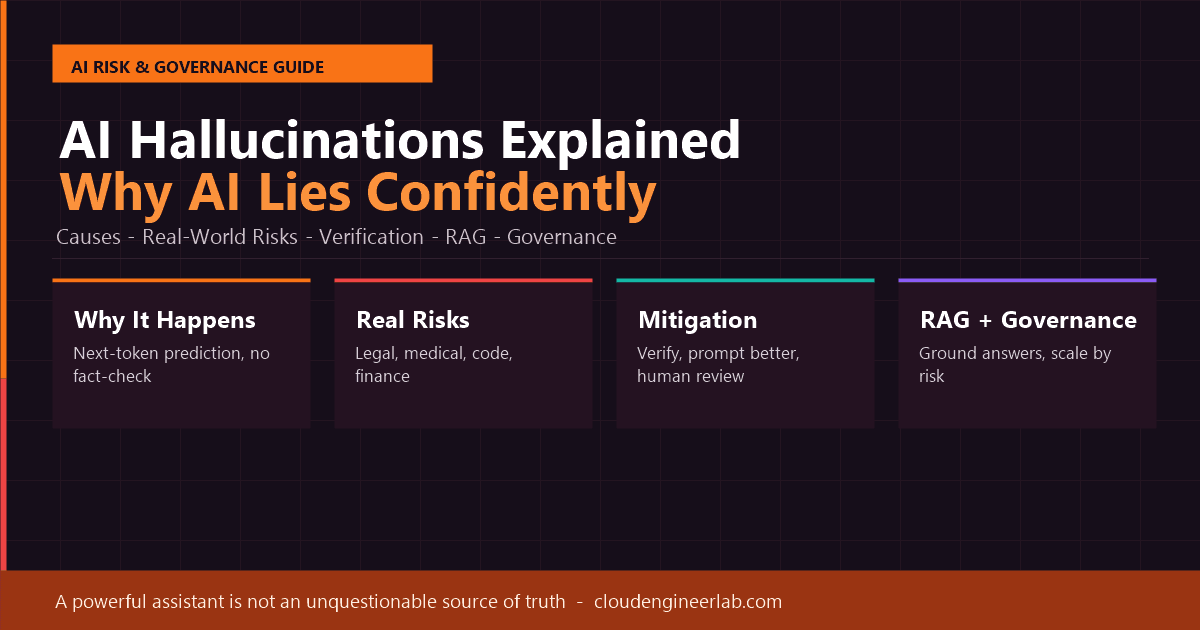
AI Hallucinations Explained: Why AI Lies Confidently, and How to Stop It Costing You
AI hallucinations aren't a bug you can patch — they're built into how generative AI works. Here's why they happen, what they cost, and the concrete techniques that reduce the risk.
A lawyer submitted a legal brief with six citations. All six case names were real-sounding. None of the six cases existed. ChatGPT had invented them, complete with docket numbers and quoted rulings — and delivered them with exactly the same fluent confidence it would use to explain a real precedent.
That story has been repeated, with different details, across law, medicine, software engineering, and journalism since generative AI went mainstream. The common thread isn't carelessness. It's that AI hallucinations look identical to correct answers — and that single fact is why this topic deserves more than a one-line warning at the bottom of a chatbot's terms of service.
This is a practical guide: what hallucinations actually are, why they're structurally unavoidable, what they cost when they go unnoticed, and — the part that matters most — the specific techniques that measurably reduce the risk in real projects.
The one sentence to remember
AI is a powerful assistant, but it should not be treated as an unquestionable source of truth.
What Is an AI Hallucination?
An AI hallucination is when a generative AI system produces information that is fabricated, inaccurate, or entirely made up — while presenting it with the same fluency and confidence as a correct answer.
It's not the AI "trying to deceive you." There's no intent involved. It's closer to a structural side effect of how these systems are built to always produce an answer.
| It looks like... | But it's actually... |
|---|---|
| A citation with a real-sounding case name, journal, or URL | Fabricated — the source does not exist |
| A confident explanation of a software function or API | Invented — the function doesn't behave that way, or doesn't exist |
| A specific statistic or date | Plausible-sounding, but not grounded in any real data |
| A summary of a document | Subtly altered — details added or dropped that weren't in the original |
The danger is in the delivery, not just the error
A search engine that fails says "no results found." An AI that fails says something fluent, specific, and wrong — with no visible difference from when it's right. That's the entire risk in one sentence.
Why Hallucinations Happen — The Real Mechanism
To understand why this can't just be "patched," you need the one core fact about how large language models (LLMs) work: they generate text by predicting the most statistically probable next word, based on patterns learned from training data.
There is no internal step where the model checks a fact against a verified database before writing it down. It is not retrieving an answer. It is generating one, token by token, based on probability.
The Specific Root Causes
| Cause | What's happening |
|---|---|
| Training data gaps | The model was never trained on this fact, so it fills the gap with the closest plausible pattern |
| Knowledge cutoff | Anything after the model's training cutoff date is a guess dressed up as knowledge |
| Ambiguous or underspecified prompts | A vague question invites the model to fill in blanks with assumptions it presents as fact |
| Long, complex outputs | The longer the generation, the more opportunities for small factual drift to compound |
| Over-confident training signal | Models are often trained to sound helpful and complete — hedging and "I don't know" responses were historically underrepresented in training and reinforcement |
| No real-time grounding | Without a live data connection, the model is working purely from memorised patterns, not current facts |
An analogy that actually helps
Think of an improv actor mid-scene. Breaking character to say "I don't know my line" isn't part of the performance — the entire skill is staying in character and producing something plausible, no matter what's thrown at them. An LLM is under that same structural pressure on every single response: produce fluent output, don't break character by admitting uncertainty.
The Real Risks — Why This Isn't Just a Curiosity
Hallucinations stop being an interesting quirk the moment AI output feeds into a real decision, document, or system.
| Domain | What a hallucination looks like | The consequence |
|---|---|---|
| Legal | Fabricated case citations in a filed brief | Sanctions, malpractice exposure, case dismissal |
| Healthcare | An invented drug interaction or dosage explanation | Patient harm, liability |
| Software development | A confidently described API method that doesn't exist | Broken builds, security vulnerabilities from misused patterns |
| Finance | A fabricated regulatory requirement or incorrect calculation | Compliance failure, financial loss |
| Business reporting | A statistic or market figure that sounds right but isn't sourced | Bad strategic decisions made on fabricated data |
| Customer support | A chatbot inventing a policy or refund term that doesn't exist | Contractual disputes, reputational damage |
| Journalism / content | A quote or event attributed to the wrong source | Published corrections, credibility loss |
The risk scales with how much you trust the output
A hallucination in a low-stakes brainstorm costs nothing. The exact same hallucination, unverified, in a legal filing, a medical note, or a production codebase can be genuinely expensive. The mitigation effort should scale with the stakes — not be applied uniformly or, worse, not at all.
Recognising the Signs of a Hallucination
You can't verify everything with equal rigor, so it helps to know what raises the odds an answer needs a closer look.
Suspiciously specific detail with no source
Exact statistics, dates, quotes, or citations offered without a traceable source are a common hallucination pattern — specificity is not the same as accuracy.
Anything about very recent events
If it's newer than the model's training cutoff, treat the answer as a guess until verified independently.
Niche or highly specialised topics
Less common subjects have thinner training data, which means more gap-filling and a higher hallucination rate.
An answer to a question that assumes something false
If you ask "why did X happen" and X never actually happened, many models will still construct a confident explanation rather than challenge the premise.
Internal inconsistency across a long response
If an AI contradicts an earlier detail later in the same answer, that's a signal the output has drifted from anything grounded.
How to Reduce Hallucinations — Practical Techniques
1. Verify AI-Generated Information
Treat every AI output as a first draft requiring confirmation, not a finished, trustworthy answer. The verification effort should match the stakes: a casual brainstorm needs none; a client deliverable, legal document, or medical reference needs full verification against a primary source.
2. Use Trusted Sources and Official Documentation
When AI explains a product feature, a legal standard, an API, or a regulation, cross-check it against the official documentation — not another AI's summary of that documentation, which just compounds the risk. Official docs, primary legal texts, and vendor documentation are your ground truth, not a second AI opinion.
3. Improve Prompts and Provide Better Context
Hallucination risk drops noticeably when you give the model less room to guess.
| Weak prompt | Stronger prompt |
|---|---|
| "What does this function do?" | "Here is the exact function code and its official documentation link — explain what it does, referencing only what's shown." |
| "What's the refund policy?" | "Here is our actual refund policy document, pasted below — summarise it accurately, and don't add anything not stated here." |
| "Explain the relevant regulation" | "Using only the attached regulation text, explain section 4.2 in plain language." |
Give it the facts instead of asking it to remember them
The single most effective prompting change is supplying the source material directly in your prompt or context window, and instructing the model to answer only from what you provided. This shifts the task from "recall a fact" (hallucination-prone) to "summarise this text" (far more reliable).
4. Apply Human Review
No mitigation technique replaces a qualified human checking the output before it's used — especially for anything published, shipped, or acted upon. Human review is the last line of defence, not an optional extra step.
5. Use Retrieval-Augmented Generation (RAG)
RAG is the most effective structural fix available today. Instead of relying purely on what the model memorised during training, RAG retrieves relevant, real documents at the moment of the question and feeds them into the model's context — so it answers from the retrieved source, not from memory alone.
This is why a well-built RAG system answering questions about your company's own policies hallucinates far less than a general-purpose chatbot asked the same question from memory — it's not recalling, it's reading.
6. Test AI Outputs Before Production
If AI output feeds into a live system — a chatbot, an automated report, a code deployment — treat it like any other software component that needs testing.
Build a test set of known-answer questions
Include edge cases, ambiguous phrasing, and questions with no correct answer — check the model handles "I don't know" gracefully rather than fabricating.
Run outputs through a review pass before shipping
Whether that's a human reviewer, an automated fact-check step, or a second model cross-checking the first.
Monitor in production, not just at launch
Model behaviour can shift after a provider update. Ongoing spot-checks catch drift that a one-time test misses.
Log and review flagged low-confidence cases
If your pipeline has any confidence signal or retrieval-match score, route low-confidence responses to human review automatically.
7. Establish Governance for High-Risk Use Cases
For anything touching legal, medical, financial, or safety-critical decisions, verification habits and good prompting aren't enough on their own — you need an actual policy.
| Governance element | What it covers |
|---|---|
| Risk classification | Define which use cases are low, medium, and high risk, and what review level each requires |
| Approved sources of truth | Specify which documents, databases, or systems AI is allowed to be grounded against for each use case |
| Mandatory human sign-off | Require a named, accountable reviewer for high-risk outputs before they're used or published |
| Disclosure requirements | Define when AI involvement must be disclosed to clients, patients, students, or the public |
| Audit trail | Keep a record of what was asked, what was retrieved (if using RAG), what was generated, and who approved it |
| Incident process | Have a defined process for what happens when a hallucination does slip through — not just prevention, but response |
Governance is a scaling problem, not a one-time policy
A single AI governance document written once and never revisited will not keep pace with how fast the tools and their failure modes change. Review and update it as regularly as you would a security policy.
Putting It Together: A Risk-Based Mitigation Framework
Not every AI interaction needs the same level of scrutiny. Match the effort to the stakes.
| Risk level | Example use case | Minimum mitigation |
|---|---|---|
| Low | Brainstorming, casual drafts, internal notes | Basic awareness that output may be wrong |
| Medium | Internal reports, first-draft code, marketing copy | Human review before anything is shared externally |
| High | Legal filings, medical guidance, financial advice, production code | RAG grounding + mandatory human sign-off + audit trail |
| Critical | Safety systems, regulatory submissions, published medical/legal content | Full governance framework + formal testing + named accountable reviewer |
The Bottom Line
AI hallucinations aren't a temporary bug waiting for a patch — they're a structural consequence of how generative AI produces language: by predicting the most plausible next word, not by consulting a database of verified truth. That won't fully disappear as models improve; it will just become less frequent and harder to spot, which is its own risk.
The organisations and individuals getting real, safe value from AI aren't the ones treating it as an oracle. They're the ones who verify before trusting, ground their AI in real sources through techniques like RAG, keep a human in the loop where it matters, and scale their governance to match the actual stakes of each use case.
Start with the one habit that matters most
Before you act on any AI answer that has a real consequence attached, ask yourself: could I point to where this fact actually came from? If not, verify it before you use it.
AI is a powerful assistant. It has earned a place in how modern work gets done. But it has not earned — and structurally cannot earn — the status of an unquestionable source of truth.

Written by
Chetan Yamger
Cloud Engineer · AI Automation Architect · Modern Workplace Consultant
Cloud Engineer, AI Automation Architect, and Modern Workplace Consultant based in Amsterdam, Netherlands. Specializing in scalable, secure enterprise solutions with Microsoft Azure, Intune, PowerShell, and AI-driven automation using ChatGPT, Gemini, and modern LLM technologies.
Stay in the loop.
New articles, straight to you.
Deep-dive technical articles on Intune, PowerShell, and AI — no noise, no spam.
Discussion
Share your thoughts — your email stays private
Leave a comment